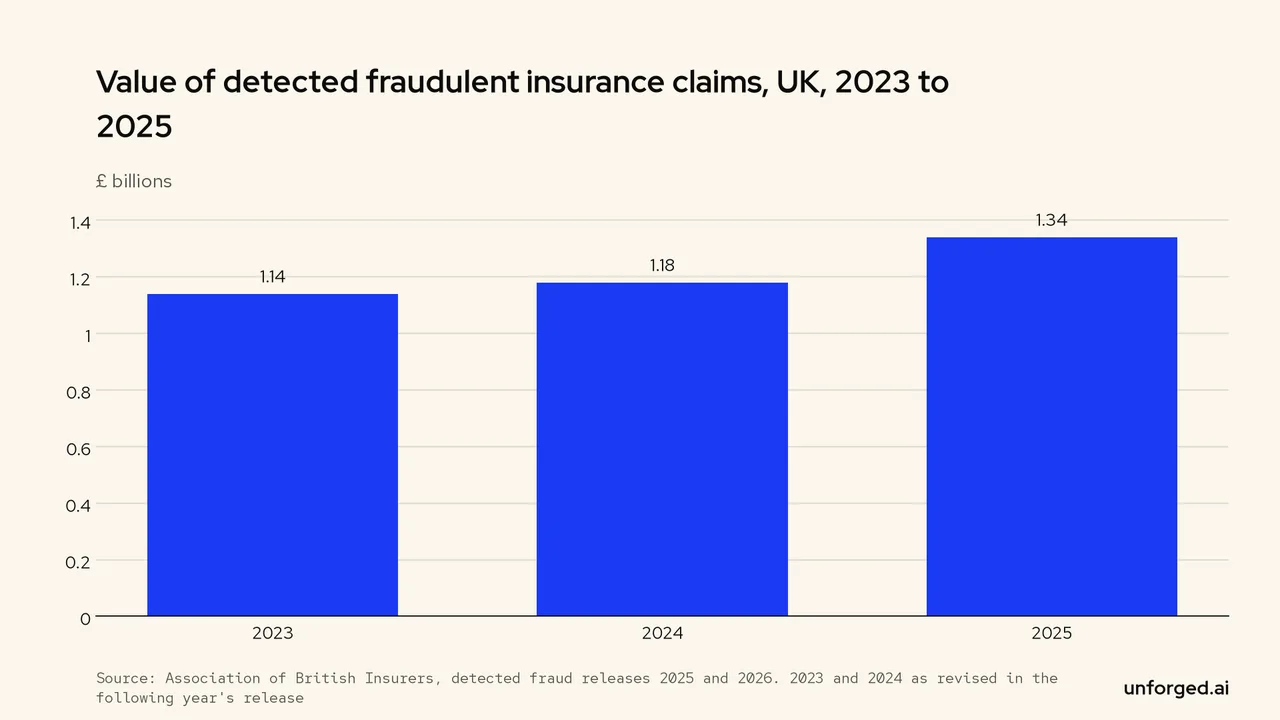
UK insurers detected 93,900 fraudulent insurance claims in 2025, worth £1.34bn. Those are the Association of British Insurers' latest figures, published on 6 October 2026. The number of cases fell slightly on the year before, while their value rose by 14 per cent, so the typical fraud that insurers catch is now larger than it was.
That answers "how much insurance fraud is there in the UK", with one large qualification. It counts only fraud that insurers found. The ABI's fraud page estimates that a similar amount goes undetected each year (that page still quotes the 2024 figures), so the real total is higher than the headline by an amount nobody can measure directly.
The 2025 figures
The ABI collects detected fraud figures from its members every year. For 2025 they show:
- 93,900 detected fraudulent claims, down 2.7 per cent on 2024. The head of the City of London Police's Insurance Fraud Enforcement Department (IFED) put that at more than 250 a day.
- £1.34bn in value, up 14 per cent on a revised £1.18bn for 2024.
- An average of £14,300 per detected fraud, the second highest the ABI has recorded, behind £14,600 in 2022.
Although the rate of detected insurance fraud fell slightly last year, our data shows that fraudsters are targeting much bigger payouts.
Separately, insurers stopped fraudulent applications for cover worth £1.8bn in 2025, with application fraud cases up 24 per cent. Application fraud means lying or withholding information to get a policy or a lower premium. It is a different measure from claims fraud and the two shouldn't be added together.
The last four years
Detected claims fraud has run at a little over £1bn a year for some time. The ABI's releases put it at £1.1bn for 2022 (as first reported), £1.14bn for 2023, £1.18bn for 2024 and £1.34bn for 2025, the 2023 and 2024 values being the revised ones given a year later. Last year's jump is the largest in the series.
The number of cases has moved around more. It fell to 72,600 in 2022, a drop the ABI tied partly to the Official Injury Claim portal, which reduced the number of small personal injury claims being made. It then rose to 84,400 in 2023 and 98,400 in 2024 as first reported, before the slight fall in 2025.
A caution on those figures: the ABI revises earlier years. Its 2025 release put 2023 at 88,100 cases, not the 84,400 first published. It first gave 2024 as £1.16bn, against the £1.18bn in its 2026 release, which also compares 2025 with a 2024 case total lower than the 98,400 originally reported. The direction of travel is clear, but year-on-year changes are best taken from the latest release rather than worked out across releases.
Where it happens
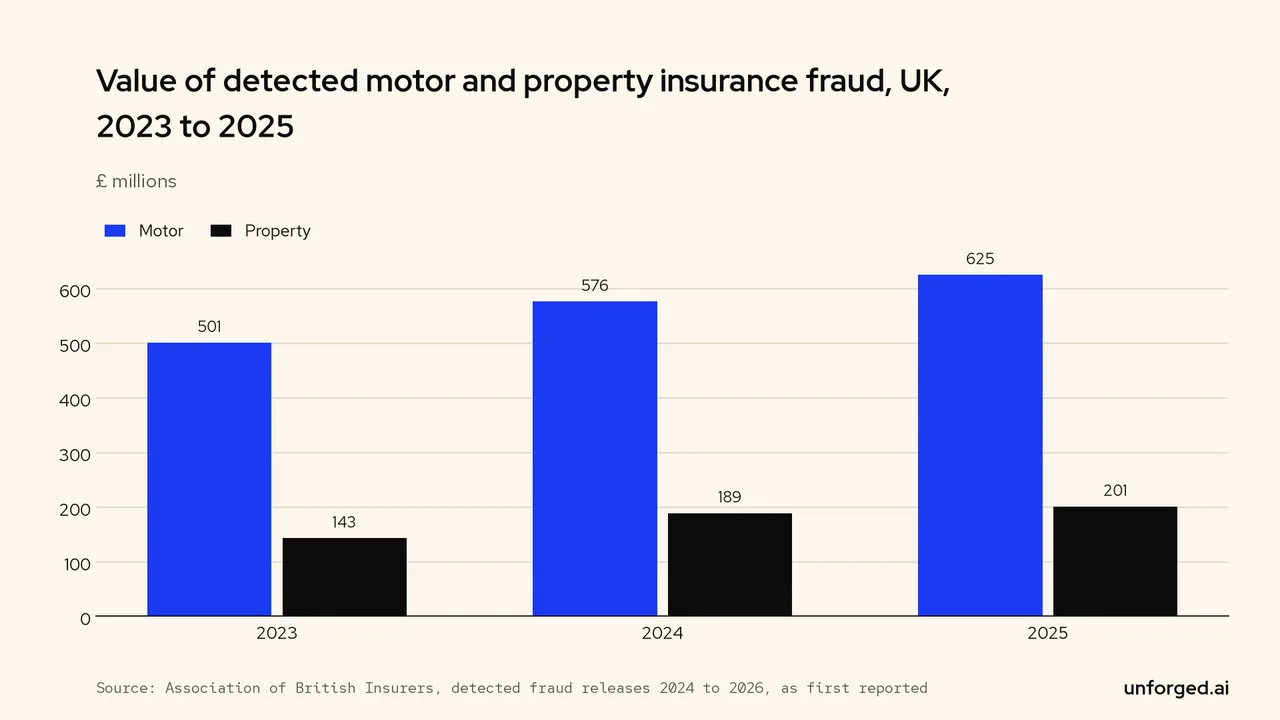
Motor insurance is where most detected fraud sits. In 2025 insurers found 51,900 fraudulent motor claims worth £625m, which is 55 per cent of all detected cases. The average detected motor fraud rose to £12,000.
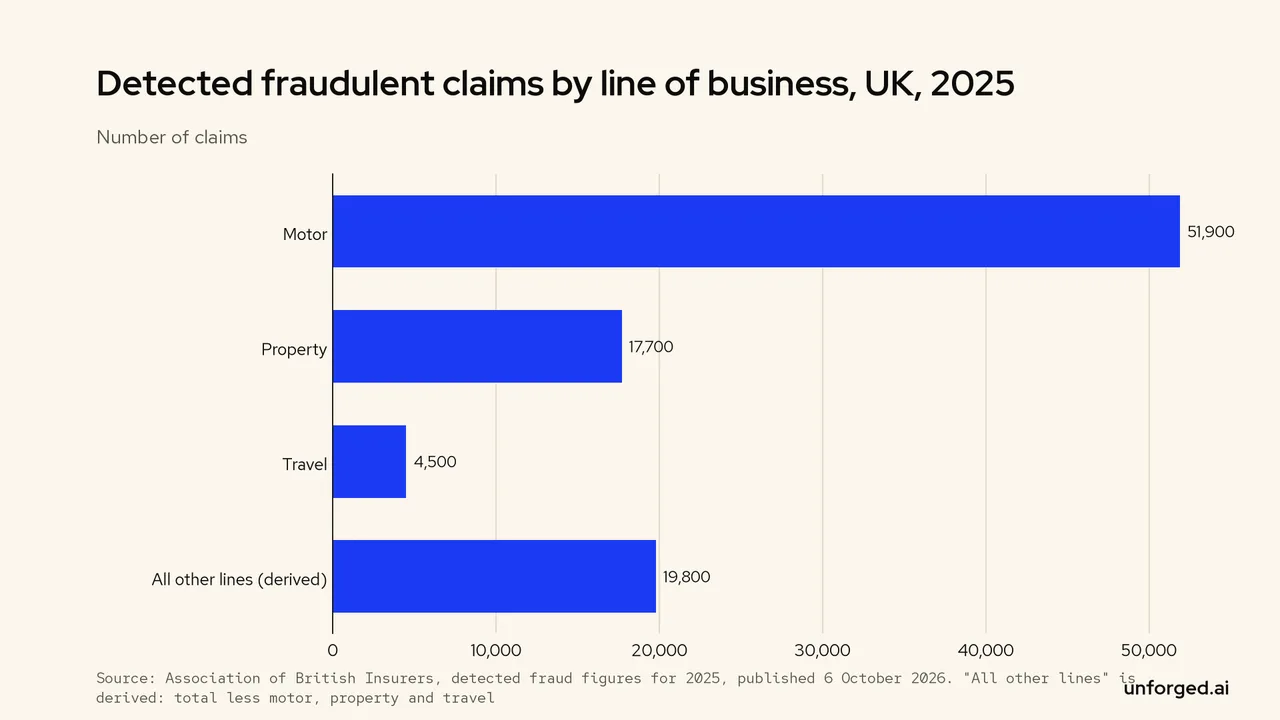
Property insurance followed the same pattern as the total, with fewer cases and more money. Detected property frauds fell 6.2 per cent to 17,700, while their value rose 3.4 per cent to £201m, a record average of £11,400. Travel was the fastest riser by volume: cases up 85 per cent to 4,500, worth £8.6m.
What kind of fraud
Since its figures for 2023, the ABI has also counted detected fraud by type. Exaggerated loss, where someone deliberately increases the cost of a claim beyond its true value, is the most common. Insurers found 26,900 such cases in 2025; in 2024 they were worth £466m. The fastest-growing type in 2025 was contrived incident and loss fraud, where the incident or loss is staged or created to make a claim, up 30 per cent to around 5,600 cases.
In motor insurance the staged version is known as crash for cash. The ABI describes three forms. In a staged accident, fraudsters crash their own vehicles together or mimic damage from a genuine crash. In an induced accident they target an innocent driver, for example by braking sharply so the car behind hits them, or by disabling their brake lights. A fabricated accident never happened at all and exists only as a claim.
The FCA's 2025 review of motor insurance claims adds what the ABI, the IFB and insurers told it about newer methods. Insurers reported a growing number of claims with altered media, and fraudsters using generative AI to create fake images of vehicle damage or videos of incidents that never took place.
The paperwork behind a false claim
Almost every claim rests on documents: invoices and receipts for what was lost, medical reports for injuries or cancelled trips, bank statements, identity documents and signed forms. The prosecutions that the ABI and IFED publicise show how often those documents are where the fraud lives.
A man jailed for 28 months in December 2025 had made false burglary claims for collectible Lego sets and other goods. His insurer raised concerns after finding the same receipts used across different claims and invoices that appeared to have been altered to match the policy address. Manufacturers and retailers confirmed that the documents were fraudulent: the invoices were either falsified or related to products that had not been sold at the time of the alleged thefts.
In another IFED case, sentenced in February 2025, a man made 25 false travel and home claims with two insurers and received £61,380. In the claims against one of them he supplied invoices from a genuine accommodation provider, which that insurer confirmed had been forged. IFED compared the bank statements he had submitted to that insurer with his real accounts and confirmed he had booked none of the flights or accommodation he claimed for. When the other insurer raised a previous fraud conviction, he sent letters that appeared to come from HM Courts and Tribunals Service and the Criminal Cases Review Commission. Both were fake.
Medical paperwork recurs. In June 2026 IFED reported a guilty plea over a travel claim supported by fabricated Caribbean medical treatment documents. The ABI's 2026 release describes a £300,000 travel insurance scam built on fake identities, fabricated medical documents and websites. Its 2023 release described a veterinary practice employee who altered invoices sent to genuine clients so they appeared to be hers, then submitted them as evidence in false pet insurance claims, 18 in all.
Signatures are part of this. In a case IFED published in 2021, a woman claimed a terminal illness benefit worth over £130,000 using a hospital letter she later admitted typing herself, finding a doctor's name online to sign it with. The insurer asked the NHS for her medical history directly; she then cancelled the claim, and the hospital confirmed she was not a current or past patient.
A pattern runs through these cases. The forgeries were mostly found by going back to whoever was supposed to have issued the document: the retailer, the bank, the hospital, the court. That works, but it depends on someone first noticing that a document deserves a second look.
For claims teams, the checks that exposed these documents were plain ones: the same receipt appearing on more than one claim, an address that had been changed to match the policy, submitted bank statements compared with the claimant's real accounts, and a direct request to the issuing hospital, retailer or court.
What the law says
Several pieces of law apply to a fraudulent claim, and they describe different consequences.
Under section 12 of the Insurance Act 2015, if an insured person makes a fraudulent claim, the insurer is not liable to pay it, may recover sums already paid in respect of it, and may treat the contract as terminated from the time of the fraudulent act.
Fraud by false representation, under section 2 of the Fraud Act 2006, was the charge in the Lego case, the February 2025 case and the June 2026 plea described above. Forged documents can also bring a charge of using a false instrument, under section 3 of the Forgery and Counterfeiting Act 1981; the February 2025 defendant pleaded guilty to one such charge as well. An "instrument" includes any document, formal or informal (section 8), and section 9 treats it as false if, among other things, it purports to have been made by a person who did not in fact make it in that form.
For personal injury claims that reach court, section 57 of the Criminal Justice and Courts Act 2015 applies where a court finds the claimant entitled to damages but, on the defendant's application, is satisfied that the claimant was fundamentally dishonest. The court must then dismiss the claim, including any parts that were not dishonest, unless the claimant would suffer substantial injustice. Signed statements carry their own risk: under rule 32.14 of the Civil Procedure Rules, proceedings for contempt of court may be brought against someone who makes, or causes to be made, a false statement in a document prepared in anticipation of or during proceedings and verified by a statement of truth, without an honest belief in its truth.
What the numbers do and don't tell you
The ABI's figures are a measure of detection, not of fraud. Insurers report cases where there has been a conviction or caution, or where the evidence of fraud is compelling, along with cases that fall into a list of scenarios the ABI considers likely to involve fraud. The ABI says some of those may have an innocent explanation. It also says the figures leave out exaggerated personal injury claims that were paid, particularly for whiplash, and claims withdrawn in normal handling without any challenge from the insurer.
So a rise in detected fraud can mean more fraud, better detection, or both, and the figures cannot separate the two. The ABI says insurers invest at least £200m a year to identify fraud.
Other bodies count different things. The Insurance Fraud Bureau, which describes itself as the industry's data hub for fraud intelligence, reported that it and its members investigated over £153.3m of suspected insurance fraud in 2024. That measures investigative work, not the total. In travel insurance, the cases that reach IFED are few against the cases insurers detect. IFED reported in June 2026 that it had received 102 referrals for travel insurance fraud over five years, with an insurer-estimated value of £4.4m. The ABI's figures show 4,500 detected travel frauds in 2025 alone. The two counts are not measured in the same way, and IFED is not the only route to the police, so they show the gap in scale rather than a share.
Checking the signature
Going back to the issuer works for an invoice or a hospital letter. A signature on a claim form or a signed statement can also be compared with the person's own earlier signatures, where the insurer holds them.
Unforged Nib is a signature verification API. It compares a signature with the person's own reference signatures and returns one of six verdicts, with reasons a claims handler or an auditor can read. It reads forms, scans, phone photos and PDFs. A failed check always goes to a person; it is never an automatic rejection.
Sources
- Association of British Insurers, Fraudsters target bigger payouts as insurers detect £1.34 billion of bogus claims, 6 October 2026 (figures for 2025)
- Association of British Insurers, Fraudulent insurance claims continue to top £1 billion, 17 November 2025 (figures for 2024)
- Association of British Insurers, No let up in crack down on insurance cheats as industry detects £1 billion worth of fraudulent claims, 25 September 2024 (figures for 2023)
- Association of British Insurers, Crackdown on insurance cheats delivering results, but average scam up to nearly £15,000, 22 August 2023 (figures for 2022)
- Association of British Insurers, Insurance fraud and Crash for cash
- Association of British Insurers, Fraud data (archived copy, June 2025)
- Financial Conduct Authority, Motor Insurance Claims Analysis: Multi-firm Review, July 2025
- Insurance Fraud Bureau, Annual Report 2024
- City of London Police, Suspects arrested after alleged fake death, multiple false transport claims and forged medical documents, 11 June 2026
- City of London Police, Man sentenced to 28 months in prison for fake stolen Lego claims, 17 December 2025
- City of London Police, Man sentenced for £60,000 worth of bogus travel insurance claims, 4 February 2025
- City of London Police, Woman sentenced for fake cancer insurance claims, 9 November 2021
- Insurance Act 2015, section 12
- Fraud Act 2006, section 2
- Forgery and Counterfeiting Act 1981, sections 3, 8 and 9
- Criminal Justice and Courts Act 2015, section 57
- Civil Procedure Rules, Part 32, rule 32.14