Yes. Since 18 November 2025 every new individual director and every new person with significant control (PSC) of a UK company has had to verify their identity with Companies House, and the people already on the register are being brought in over a 12-month transition that ends in mid-November 2026. A director who acts without being verified commits an offence, and so does the company, together with every officer in default.
With about a month of the transition left, Companies House's latest official figures show that just under half of the appointments in scope had been verified by 30 June 2026. The Insolvency Service secured its first convictions in September. This piece sets out what the law says, who has to do what and when, why Parliament wanted it, and what the numbers show so far. It describes the rules; it is not legal advice.
What the law says
The requirement comes from the Economic Crime and Corporate Transparency Act 2023, which works mostly by amending the Companies Act 2006.
Section 43 inserts a new section 167M. It says an individual "must not act as a director of a company unless the individual's identity is verified", and places a matching duty on the company to make sure that doesn't happen. Breaching the first is an offence by the individual; breaching the second is an offence by the company and every officer in default. Both are punishable by a fine. The same section adds that these offences are the only consequence: a contravention "does not in any way affect the validity of an individual's acts as a director".
Section 64 does the same for PSCs. An existing PSC must deliver a statement confirming their identity is verified within 14 days beginning with an appointed day set by regulations, and a new PSC who has not given verification details when registered can be directed to deliver one within 14 days. In both cases the registrar may extend the period by up to 14 days at a time. Section 65 defines what "identity is verified" means: either Companies House has verified the person itself, or an authorised corporate service provider (ACSP) has done so and delivered a verification statement naming its anti-money laundering supervisor.
Behind all of this sit the registrar's new statutory objectives, added by section 1. Among them: that information on the register is accurate, and that the registrar's records "do not create a false or misleading impression to members of the public".
Who has to verify, and when
The timetable for people already on the register is set by the Commencement No. 6 and Transitional Provisions Regulations 2025 (SI 2025/1118), which brought section 43 and most of section 64 into force on 18 November 2025 and defined the transitional period as "the period of 12 months beginning with 18th November 2025". Companies House's guidance, last updated on 30 July 2026, applies it as follows.
- New directors must be verified before the company is incorporated or before their appointment is notified. A new company's registration filing must include each director's personal code.
- Existing directors are verified through the company's next confirmation statement filed during the transition. The company delivers an identity verification statement for each director with it. Under the regulations, where the confirmation statement was not already overdue on 18 November 2025, the section 167M prohibition applies to an existing director only from the day after the company files that statement or, if it doesn't, the day after its filing deadline passes.
- Existing PSCs who are also directors have a 14-day period starting the day after the company's confirmation statement date. Filing the confirmation statement early doesn't move it.
- Existing PSCs who are not directors have a 14-day period starting on the first day of their birth month. Under the regulations, those start dates run from 1 December 2025 for December birthdays to 1 November 2026 for November ones.
- New PSCs added after 18 November 2025 can give their code when they are registered or within 14 days.
In most cases a person verifies once and receives a personal code, then gives that code for each role they hold. Someone who is both director and PSC of the same company gives it twice. Verification is free through GOV.UK One Login, by app or browser and in some cases at a Post Office, or it can be done through an ACSP such as an accountant or formation agent.
Some groups are not yet covered. Companies House says verification will come later for limited partnerships, corporate directors, corporate members of LLPs, officers of corporate PSCs, and people who file documents. Its transition plan, updated in August 2026, puts compulsory verification of presenters, and the requirement for third-party filing agents to register as ACSPs, at no earlier than November 2027, with at least six months' notice. A PSC who has died does not need to be verified.
Each director's and PSC's due dates are shown on their entry on the Companies House register. If you hold several roles, check each one: the code is the same, but it has to be supplied for every appointment, and a PSC's window is only 14 days.
Why Parliament wanted it
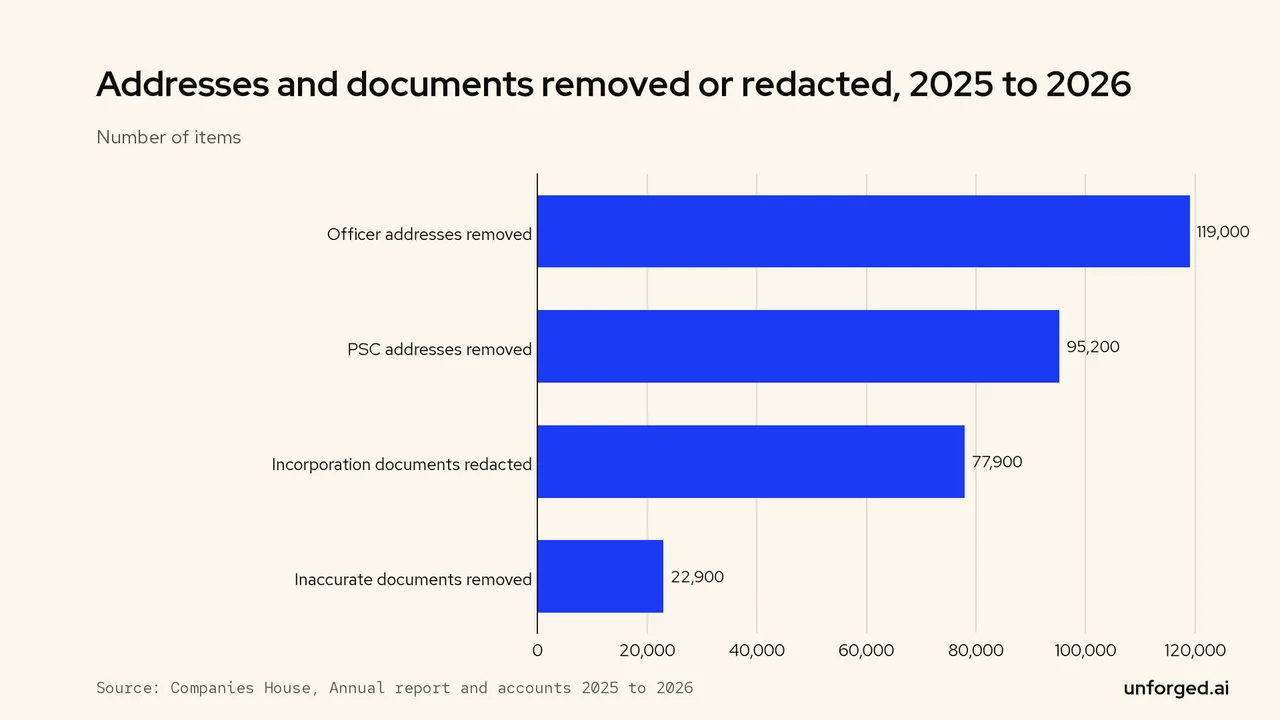
Companies House's chief executive describes the change as a move "from a passive register to a trusted guardian of critical data". The old weakness was simple: people's names and details could be put on the register without their knowledge. In 2025 to 2026 alone, Companies House redacted personal data from 77,900 incorporation documents where it had been used without consent.
The government's factsheet on the Act states the aim directly: verification "will make it much harder to register fictitious directors or beneficial owners". Companies House added at launch that it would make it easier to expose disqualified directors and to link multiple directorships to one person.
The government's third progress report on the Act, laid in June 2026, cites Companies House's 2026 to 2027 Strategic Intelligence Assessment: around 50 per cent of register abuse is thought to relate to fraud and another 25 per cent to illicit finance. Among the common forms it lists are false filing, address misuse and front directors.
Company hijacking is the clearest example of why identity matters. Companies House's guidance on corporate identity theft says fraudsters "are known to hijack a company by changing the details of the company's directors and registered office", which leaves the company open to further fraud. That page, last revised in 2021, put the number of cases Companies House dealt with at around 50 to 100 a month.
The 2025 to 2026 casework shows the other side of the problem. Companies House's annual report describes a community in Northern Ireland where people were targeted on social media and paid to hand over personal details, which were then used to set up fraudulent companies. Three linked firms that had registered more than 11,000 UK companies for overseas clients, many with no real UK presence, were wound up by the High Court after an Insolvency Service investigation. The progress report adds a case of five companies shut down after filing false and in some cases forged accounts claiming turnover of up to £642 million, which falsely named reputable accountants and solicitors as auditors.
What the numbers show so far
Take-up began before it was compulsory. Voluntary verification opened on 8 April 2025 and more than a million people had completed it by November.
By 31 March 2026 the progress report says Companies House had issued 3.81 million personal codes, linked to 3.74 million appointments. The annual report gives the routes: 3 million through GOV.UK One Login and 783,000 through ACSPs.
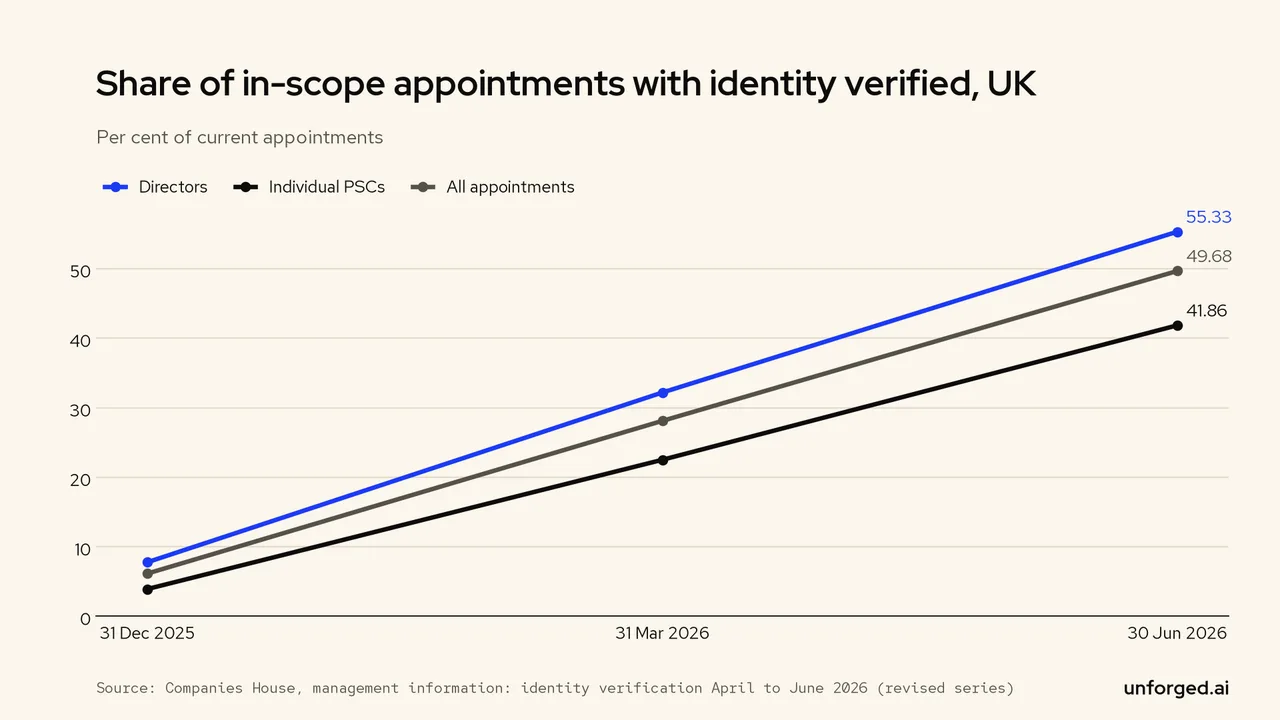
The more useful measure is the quarterly identity verification statistics, which count verified appointments as a share of all appointments in scope. The latest edition, published on 30 July 2026, shows 7,364,599 verified appointments at 30 June 2026, or 49.68 per cent. For directors the figure was 55.33 per cent; for individual PSCs, 41.86 per cent. These are appointments rather than people, and one person can hold many. The July edition also revised the earlier quarters after dormant companies were added to the count. The verified total for 31 March 2026 rose from 3,753,653 in the April edition to 4,158,941, while the share verified moved from 28.49 to 28.12 per cent. The revised March total is higher than the 3.74 million linked appointments in the progress report, which counts a different thing.
The PSC figure lagging behind is what the timetable would predict, since non-director PSCs are spread across birth months that run to November. For scale, there were 5,516,377 companies on the register at the end of June 2026, and Companies House expects 6 to 7 million individuals to have verified by November 2026. Its own transition plan uses a different estimate, "more than 7 million" existing directors and PSCs, which suggests the final count is not settled.
Companies House reads the requirement as having prompted people to review their company details. In the week before 18 November 2025, accepted director changes rose to 18,500, 68 per cent more than at the same time in 2024. There were 139,000 applications to strike off a company between 18 November 2025 and 31 March 2026, 24 per cent more than in the same period a year earlier.
Enforcement and the wider clean-up
Companies House says its approach is proportionate: reminders first, then penalties, prosecution or referral where companies don't comply. By the time of the June 2026 progress report it had sent two million email nudges and more than three quarters of a million default letters.
The Insolvency Service secured its first convictions for these offences on 16 September 2026, when it prosecuted three directors of two companies at City of London Magistrates' Court. Two had signed or delivered company accounts while unverified. The third had verified their own identity but was convicted for failing to stop an unverified co-director from acting. The fines ranged from £80 to £307, plus costs, and all three were also convicted over late confirmation statements. The sums are small. The more telling detail is that the company's duty to keep unverified people from acting is being enforced against fellow directors, not only against the person who failed to verify.
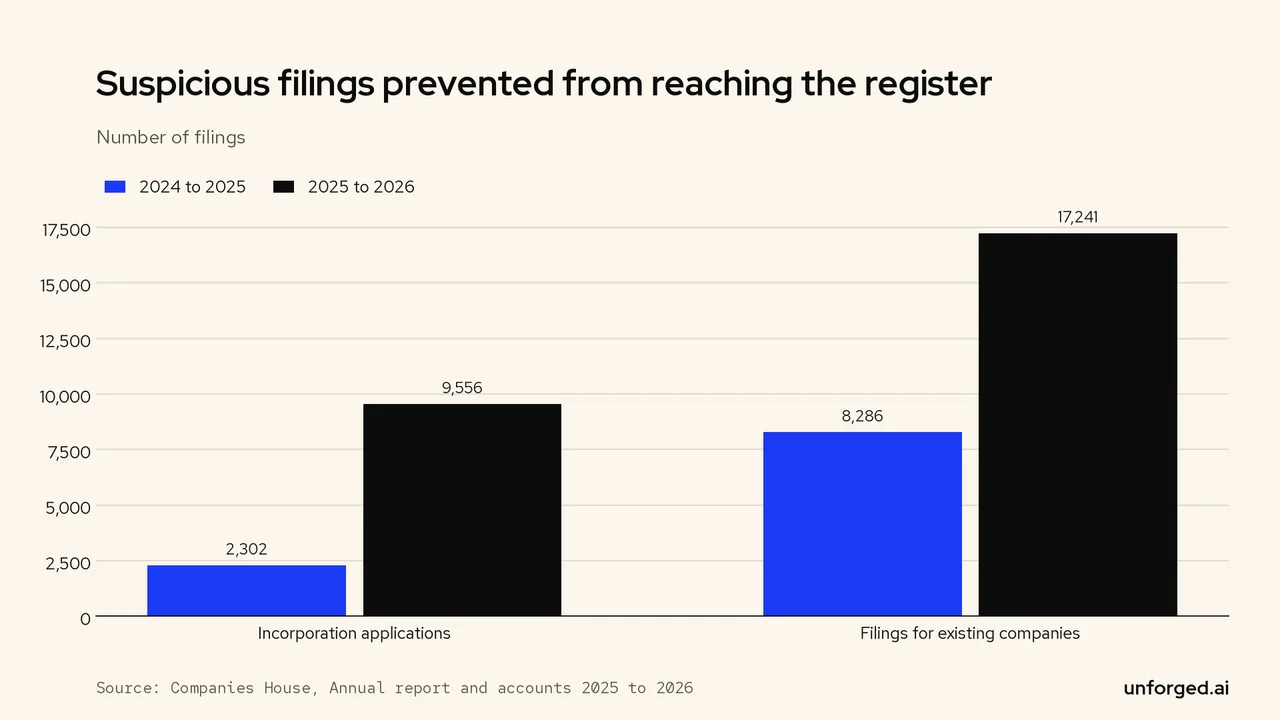
Verification sits alongside the registrar's other new powers, and those numbers are larger. In 2025 to 2026 Companies House stopped 26,797 suspicious filings before they reached the register, against 10,588 the year before.
It also cleaned up material already on the register: inappropriate officer and PSC addresses, personal data used without consent, and documents containing inaccurate or misleading information. Separately, it reports 151,000 registered office addresses removed as part of tackling address misuse, though its June press release dates that figure from March 2024, so it is not strictly a single-year number. In all, the annual report counts targeted action against 157,679 companies.
What verification does and doesn't settle
Identity verification answers one question: is the person named as a director or PSC a real individual whose identity has been checked? That should make it much harder to invent a director or to appoint one using someone else's identity.
It does not check what verified people file. The false-accounts cases above, and seven linked companies wound up in September 2026 over accounts with apparently false auditor information, are about the content of filings, not the identity of the filer. Presenters themselves are not planned to need verification until November 2027 at the earliest. And because section 167M leaves an unverified director's acts valid, the offence punishes the person without unpicking what they signed.
Checking the signature, not just the person
A verified director is one Companies House has identified. Anyone relying on a document that director has signed still has a narrower question: whether that director actually signed this page. Unforged Nib is a signature verification API. It compares a signature with the person's own reference signatures and returns one of six verdicts, with reasons. A FAILED verdict always goes to a person; it is never an automatic rejection.
Sources
- Economic Crime and Corporate Transparency Act 2023, sections 1, 43, 64 and 65
- The Economic Crime and Corporate Transparency Act 2023 (Commencement No. 6 and Transitional Provisions) Regulations 2025, SI 2025/1118
- Companies House, When you need to verify your identity for Companies House, updated 30 July 2026
- Companies House, Economic Crime and Corporate Transparency Act: outline transition plan for Companies House, updated August 2026
- UK government, Economic Crime and Corporate Transparency Act: identity verification and authorised corporate service providers (factsheet)
- Companies House, Notice served on bogus directors as Companies House changes come into force, 18 November 2025
- Companies House, Companies House confirms identity verification rollout from 18 November 2025, 5 August 2025
- Third progress report on the implementation and operation of Parts 1 to 3 of the Economic Crime and Corporate Transparency Act 2023, June 2026, covering 1 April 2025 to 31 March 2026
- Companies House, Annual report and accounts 2025 to 2026, HC 477, July 2026
- Companies House, Management information: identity verification April to June 2026, 30 July 2026
- Companies House, Incorporated companies in the UK: April to June 2026, 30 July 2026
- Companies House, Protect your company from corporate identity theft
- Companies House, Progress made in cleaning up Companies House register, 11 June 2026
- The Insolvency Service and Companies House, Directors warned to verify identities following first Insolvency Service prosecutions, 17 September 2026
- The Insolvency Service and Companies House, Seven linked companies shut down after Insolvency Service investigation with Companies House, published 24 September 2026, updated 14 October 2026