Signature verification asks a narrow question: was this signature written by the person whose name it bears? A bank clerk glancing at a specimen card, a forensic document examiner preparing evidence for court and an automated system reading a scanned form are all trying to answer it, and all of them depend on the same thing, a comparison with that person's own genuine signatures.
What differs is how carefully the comparison is made and what it is allowed to conclude. This piece follows the published European, UK and US guidance for examiners, then looks at how automated verification is tested.
What a forensic examiner compares
The European reference is the European Network of Forensic Science Institutes' Best Practice Manual for the Forensic Handwriting Examination (ENFSI-BPM-FHX-01), whose fourth edition was issued in September 2022. It rests on five principles. Two are the familiar ones: no two people write exactly alike, and no one person writes exactly the same way twice. A third explains why forgery can be detected at all. Nobody can imitate every feature of another person's handwriting while also writing at that person's speed and skill.
The examination is visual and methodical. The manual lists the general features to record: style and legibility, size, proportions, spacing, slope, and fluency and pressure. Fluency covers connecting strokes, tapered ends and variation in pressure, along with pen lifts and tremor. Examiners also look for signs of tracing, such as pencil guidelines or indentations around the signature.
Not every signature gives much to work with. The manual warns that initials or very short signatures may not contain enough characteristics to identify the writer, because they are easy to copy. A complex signature, or one the writer produces in a single well-practised movement, is harder to simulate.
In the US the equivalent document is ANSI/ASB Standard 070, Standard for Examination of Handwritten Items, published by the American Academy of Forensic Sciences' Standards Board and approved by ANSI in October 2022. Its procedure has the examiner judge how easily the questioned signature could be simulated, look for signs of slow writing (stops, hesitations, retouching, a drawn line, unvaried pressure, unnatural tremor) and then compare comparable parts of the questioned and known writing side by side. A conclusion, it says, is not based solely on any one characteristic but on the combination.
Neither document ends in a plain yes or no. ENFSI asks examiners to weigh their findings against at least two competing propositions, typically that the reference writer wrote the signature or that someone else did, and to express the strength of the evidence as a likelihood ratio, either as a number or on a verbal scale. ASB 070 lists similar hypotheses, including one that matters in practice: that the known writer produced the questioned signature "in a distorted manner".
In England and Wales the Forensic Science Regulator's statutory Code of Practice, version 2, issued under section 2 of the Forensic Science Regulator Act 2021 and in force since 2 October 2025, defines "Document handwriting" (activity MTP 700) as examining handwriting to determine who wrote it, including signatures, and evaluating the strength of that evidence. The Code applies to work for the criminal justice system, and compliance is shown by accreditation to ISO/IEC 17025:2017. It expressly excludes reading personality traits from handwriting.
Offline and online signatures
An offline signature is an image of ink on paper, scanned or photographed. An online signature is recorded while it is being written, as a series of points over time.
ENFSI's manual gives these digitally captured signatures their own appendix, and defines one as a signature "digitised by chronological sampling of the writing movement". Depending on the device, each point can carry X and Y coordinates, a time and a pressure value, and an active stylus can also record movements made just above the surface. The manual separates static characteristics, the ones visible in an image such as style, size, proportions and slant, from dynamic ones related to pressure and time.
Much of what an examiner looks for in ink is evidence of movement: on paper, speed, hesitation and pressure are inferred from the line, while an online signature measures them. But pictures of online signatures have limits: ASB 070 says images rendered from them "may exhibit poor quality and distortion", and leaves examination of the underlying pen data outside its scope.
An offline check may also be working from a copy: ENFSI counts photocopies, faxes, scans and photographs as non-original. ASB 070 lists what a reproduction can hide, among them guidelines, the type of pen, stroke direction, pressure, the order of strokes and hesitations. The UK Code covers both kinds: its handwriting activity applies to images of original signatures and to signatures captured "via a digitiser and stylus".
Simulated, disguised and random forgeries
Simulation is someone else trying to copy the genuine signature. ENFSI defines it as "an attempt to copy or reproduce writing or a signature". It can be freehand, from a model the forger has studied, or traced, with the model placed under the paper or transferred as indentations or pencil lines and then written over. ASB 070 notes that a practised freehand simulation may not show the slow, drawn qualities examiners expect, and that a fast simulation tends to show the forger's own habits instead. Researchers call these skilled forgeries.
Disguise is the genuine writer deliberately altering their own signature. The dataset description for the 4NSigComp2010 competition puts the motive plainly: an attempt "to avoid being identified or for him/her to deny writing the signature". ENFSI's fifth principle accepts the limit this sets. Where writers disguise their own handwriting or imitate someone else's, it is not always possible to identify the author.
Random forgery covers signatures made with no attempt at imitation. ENFSI's word is spurious: a signature "created without the apparent use of a model" that bears no resemblance to the genuine one. In research the term often means something narrower, the genuine signature of a different person used as an impostor sample. The UTSig paper defines a random forgery as one "completely dissimilar to the genuine signature".
This matters for automated verification. Telling a signature apart from somebody else's genuine signature is a different task from telling it apart from a practised imitation, and research benchmarks test and report the two separately.
Why reference signatures matter
ENFSI's sampling appendix says reference specimens should reflect the writer's natural variability and correspond to the questioned signature in style and in date of writing. It distinguishes course-of-business specimens, written in everyday life on letters, forms or cheques, from requested specimens written for comparison. For requested samples it recommends the same type of pen as the questioned signature, and the subject must not be shown the questioned writing.
ASB 070 is blunter about the risks. Specimens collected only by an interested party "may not reflect a writer's full range of variation", and a lack of writing from around the same date can hamper the assessment of differences. It also sets a high bar for treating a difference as evidence of another writer. A feature that appears in even one known specimen is within the writer's repertoire, and treating its absence as significant needs "extensive known specimens from multiple sources, over a large timeframe".
ASB 070 also lists what changes a person's writing, from age, illness and medication to an awkward position, the pen, the paper, cold, fatigue and haste. A single reference cannot show how much of that variation is normal for one person.
If you keep reference signatures for customers or clients, the examiners' guidance suggests a practical reading: hold more than one, from different dates, ideally written in the normal course of business on the kind of document you will be checking, and keep originals or good images rather than photocopies.
How automated verification is studied
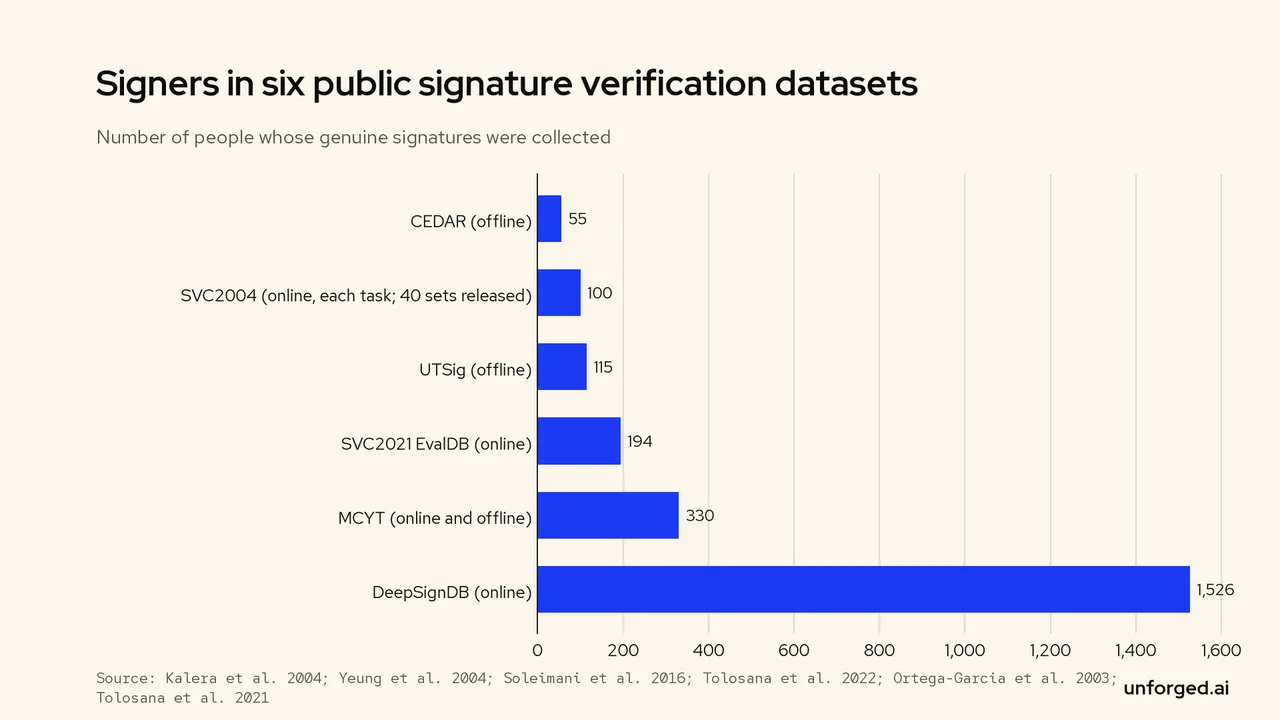
Automated systems are developed and compared on public research datasets, whose make-up shapes what any published result means. Their sizes, from the papers that describe them:
- CEDAR (University at Buffalo): 55 writers with 24 genuine signatures each, and 24 forgeries per writer from about 20 skilful forgers, scanned at 300 dpi. An offline set, described by Kalera, Srihari and Xu in 2004.
- MCYT (four Spanish institutions): 330 people, each with 25 genuine signatures and 25 skilled forgeries, 16,500 in all, written with an inking pen on paper over a tablet so that each exists both as pen data and as an image. The 2003 corpus paper says the forgers were five other contributors who practised at least 10 times.
- SVC2004, the First International Signature Verification Competition: two online databases of 100 signature sets each, with 20 genuine signatures and 20 skilled forgeries per set, of which the first 40 sets were released. For privacy, contributors were advised not to use their real signatures but to design and practise a new one.
- UTSig (University of Tehran): 8,280 Persian offline images from 115 people, each with 27 genuine signatures, 3 written with the opposite hand and 42 skilled forgeries by 6 forgers.
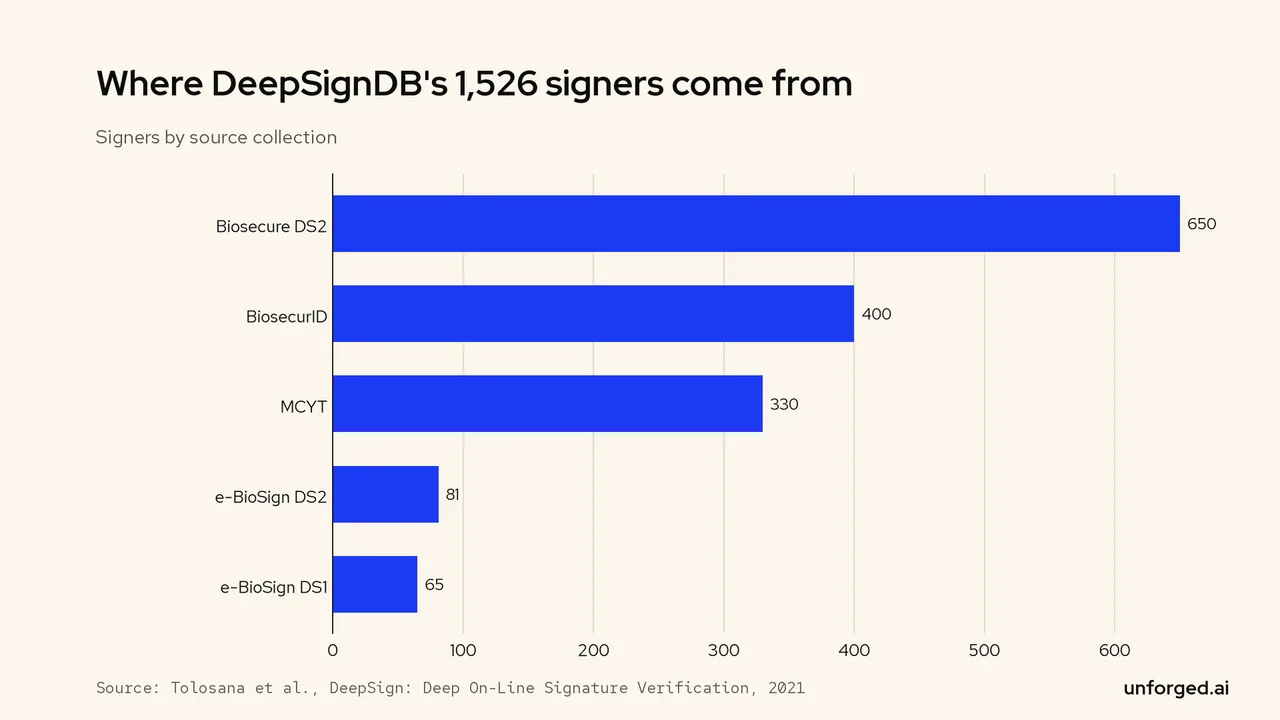
- DeepSignDB (Universidad Autónoma de Madrid): online signatures from 1,526 people, combining MCYT, BiosecurID, Biosecure DS2 and two e-BioSign collections, captured on eight devices, some with a finger rather than a stylus. (paper)
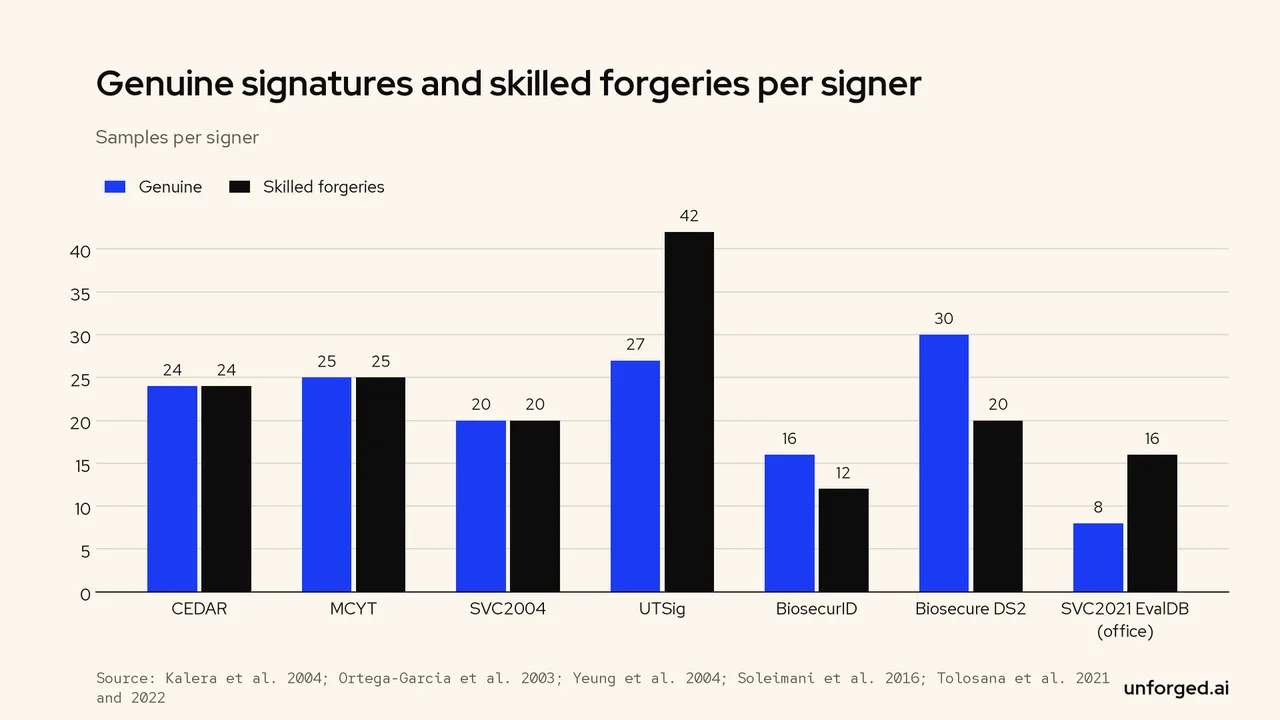
Some patterns recur. The forgers are other people recruited for the task, often fellow contributors, who practise before imitating the genuine signatures. Genuine signatures are collected in between one and four sessions, from a single sitting to sessions months apart, so they capture only part of how a signature changes over time. And the signers come from particular places: UTSig was built because Persian signatures, often cursive and independent of the person's name, differ from the Western, Chinese and Japanese signatures in earlier datasets.
The International Conference on Document Analysis and Recognition (ICDAR) has hosted competitions to make results comparable. SigComp2009 used signatures collected at the Netherlands Forensic Institute, authentic signatures from 100 writers and forgeries from 33, written on paper over a tablet so that 1,953 online and 1,953 offline files exist. SigComp2011 added Chinese signatures to Dutch ones. SigWiComp2013 used new Dutch and Japanese data and SigWIcomp2015 Bengali, German and Italian. Both asked entrants for the probability of the evidence if the signature is authentic and if it is not, the examiner's likelihood framing. At the International Conference on Frontiers in Handwriting Recognition in 2010, 4NSigComp2010 included disguised signatures: its training set held 200 questioned signatures, of which 76 were genuine, 104 simulated and 20 disguised.
The ICDAR 2021 Competition on On-Line Signature Verification has since become SVC-onGoing, an open benchmark. Its final evaluation uses a new database of 194 people: 75 signing with a stylus in an office, and 119 signing with a finger on their own phones, unsupervised, across 94 smartphone models.
What the research numbers don't tell you
This article quotes no error rates, on purpose. Results in the literature depend on the dataset, the number of references a system is given, and whether it is tested against random or skilled forgeries. UTSig's authors put "incomparable reported results" down to different training and test conditions, and the SVC2004 organisers said their competition "should not be considered as an official certification exercise", because the data was gathered in a laboratory rather than in real use.
A figure from one dataset says little about how a system will do on one organisation's own forms, scans and signers. The more useful questions are the ones an examiner would ask: how many references there are for this person and from when, whether the questioned signature is an original, and whether the result comes with reasons rather than as a bare verdict.
Checking signatures in practice
Unforged Nib is a signature verification API. It compares a signature with the person's own reference signatures, up to 10 per person, and returns one of six verdicts, with reasons. It reads signatures in Latin script today. A FAILED result, strong evidence of a different writer or of a copy of a reference, always goes to a person; it is never an automatic rejection.
Sources
- ENFSI, Best Practice Manual for the Forensic Handwriting Examination, ENFSI-BPM-FHX-01, Edition 04, September 2022
- AAFS Standards Board, ANSI/ASB Standard 070, Standard for Examination of Handwritten Items, first edition, 2022 (PDF)
- Forensic Science Regulator, Forensic science activities: statutory code of practice, version 2, in force from 2 October 2025 (PDF)
- Forensic Science Regulator Act 2021, section 2
- Kalera, Srihari and Xu, Offline signature verification and identification using distance statistics, IJPRAI, 2004 (CEDAR dataset)
- Ortega-Garcia et al., MCYT baseline corpus: a bimodal biometric database, IEE Proceedings, 2003
- Yeung et al., SVC2004: First International Signature Verification Competition, 2004
- Soleimani, Fouladi and Araabi, UTSig: A Persian offline signature dataset, preprint, 2016
- Tolosana et al., DeepSign: Deep On-Line Signature Verification, 2021 (DeepSignDB)
- Tolosana et al., SVC-onGoing: Signature Verification Competition, 2022
- IAPR TC11 dataset pages: SigComp2009, 4NSigComp2010, SigWiComp2013, SigWIcomp2015