Property fraud, in the sense HM Land Registry uses it, means someone posing as the owner of a house or flat and applying to sell it or mortgage it without the owner knowing. HM Land Registry said in 2025 that media stories may have left homeowners fearing it is increasing dramatically. The registry handles every application to change the register, so its figures are the place to check, but they are spread across annual reports, guidance pages and blog posts.
Put together, they give a fairly clear answer. Attempts are rare in proportion to the volume of property dealing. The registry stops dozens a year at the application stage, and in the latest two years only four or five fraud and forgery claims a year were paid. A case that gets through can take more than a year to put right, and the largest single payment in a year has run to hundreds of thousands of pounds. The figures below cover England and Wales, the area HM Land Registry serves.
How common it is
In 2024-25 HM Land Registry received 4,429,092 applications to create or update the register. It identified 86 of them as fraudulent, which it puts at just over 0.0019 per cent, or roughly one application in every 51,500.
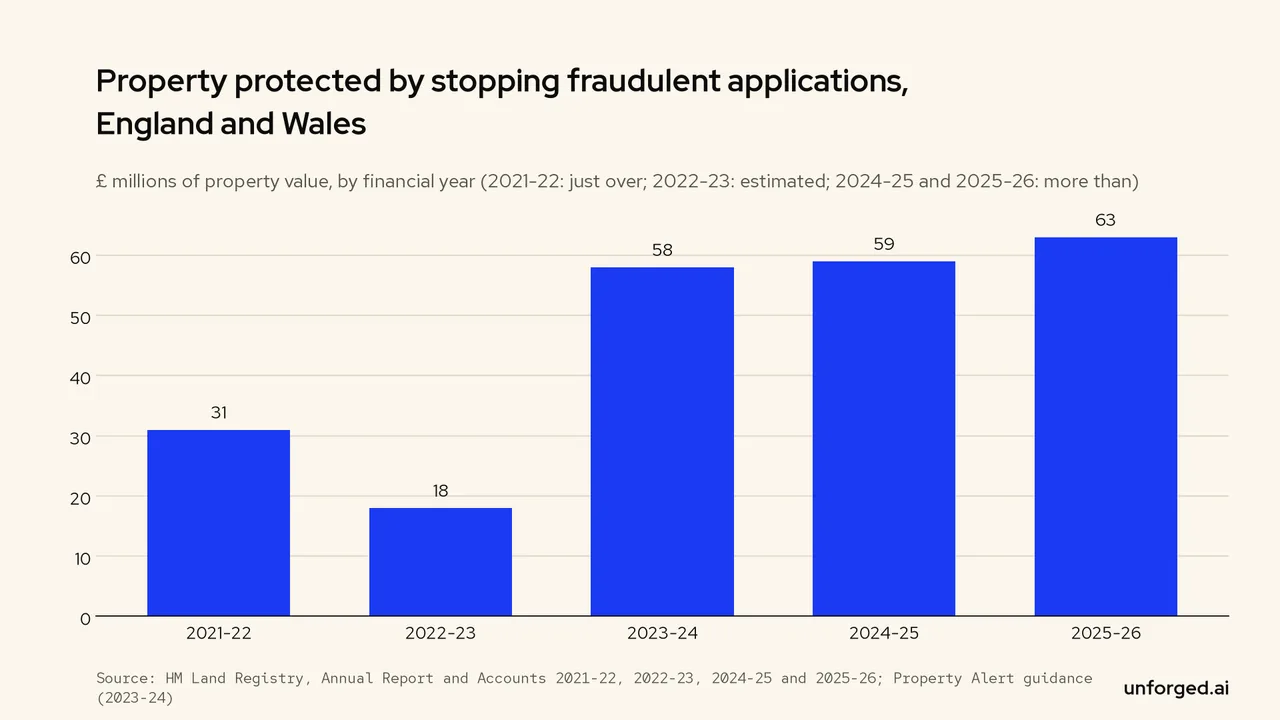
The value of the property involved is larger than the count suggests, because the homes fraudsters go for tend to be valuable and mortgage-free. HM Land Registry's own figures for the property it protected by stopping fraudulent applications run as follows:
- 2021-22: 44 fraudulent applications stopped, on properties worth just over £31m.
- 2022-23: 41 applications, on properties worth an estimated £18m.
- 2023-24: 97 attempts, on properties valued at £58m.
- 2024-25: 86 applications identified as fraudulent, with registration prevented against property worth more than £59m.
- 2025-26: fraudulent applications worth more than £63m. The same annual report elsewhere describes suspected fraudulent applications cancelled against approximately £60m worth of property, so the two passages are not measuring quite the same thing.
The registry also publishes running totals. By November 2018 the registry said it had prevented 279 fraudulent registrations since 2009, on property worth £133.4m combined. Its 2024-25 annual report put the running total at 669 since 2009. Between 2020 and 2025 alone it prevented fraudulent applications against more than 300 properties worth over £194m.
Two cautions apply. These are attempts that were caught, so they say as much about the registry's checks as about the fraudsters' appetite. And the values are what the properties were worth, not what anyone would have walked away with.
What gets through, and who pays
The register in England and Wales is more than a record. Under section 58 of the Land Registration Act 2002, once a person is entered as proprietor, the legal estate is deemed to be vested in them as a result of the registration, even if it would not otherwise be. Its only exception, in subsection (2), covers a disposition with a further registration requirement still to be met; it does not mention forgery.
The counterweight is the state guarantee in Schedule 8 to the Act. A person who suffers loss because the register is rectified, or because of a mistake whose correction would involve rectification, is entitled to be indemnified by the registrar. Paragraph 1(2)(b) deals with forgery directly: where the register is rectified, a proprietor claiming in good faith under a forged disposition is treated as having suffered loss by rectification as if the disposition had not been forged. Paragraph 5 rules out indemnity for loss caused wholly or partly by the claimant's own fraud, or wholly by their own lack of proper care, and reduces it where carelessness contributed. Paragraph 10 lets the registrar recover what it paid from anyone who caused or substantially contributed to the loss by fraud.
The annual reports break indemnity payments down by type of claim. Fraud and forgery claims paid, including costs, look like this:
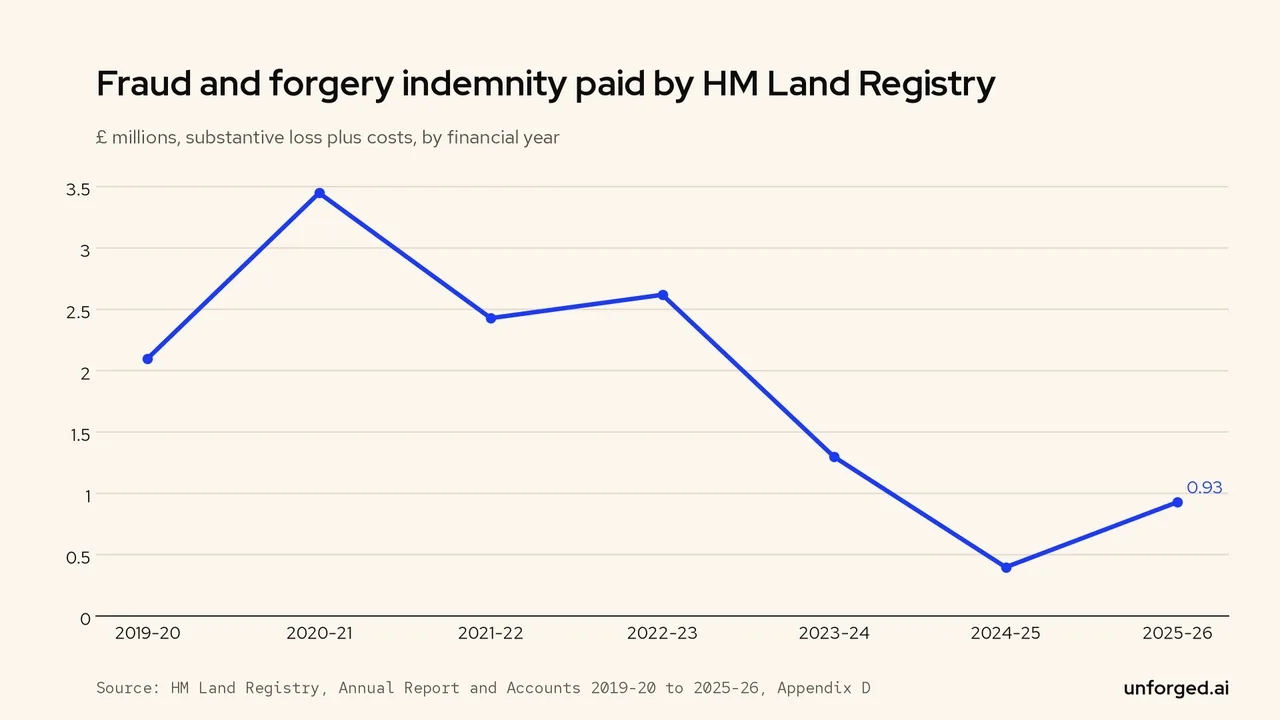
In 2025-26 HM Land Registry paid £932,886 on five fraud and forgery claims: £779,088 for the loss itself and £153,798 in costs. That was 38 per cent of the £2,441,709 it paid on all 775 indemnity claims that year. The largest single payment of the year, £580,183, was for a forged transfer of whole. The year before, four fraud and forgery claims cost £398,964, the lowest figure in the seven years shown. The peak was 2020-21, at £3.45m on 17 claims.
The registry warns that payments in a year may not relate to that year's applications, because fraud can take time to detect, investigate and put right. New claims received give an earlier view, and they are lumpy:
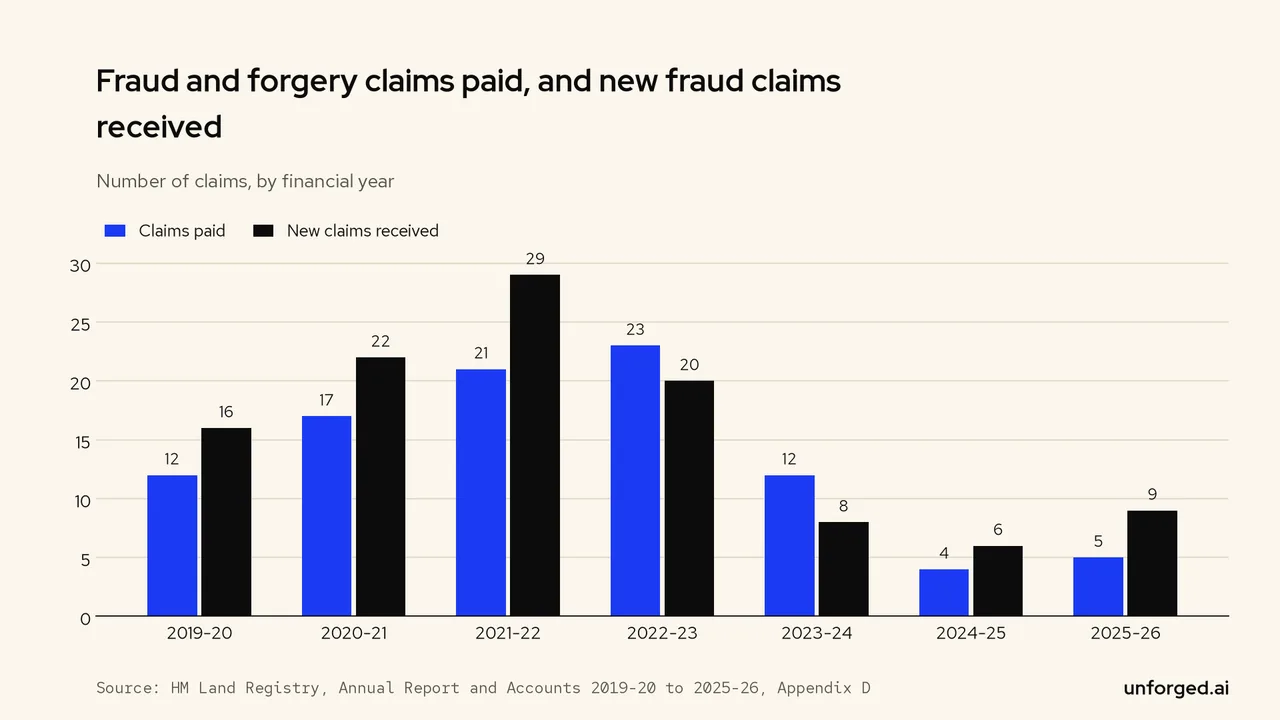
In 2025-26 the registry received nine new fraud claims valued at £6,026,500. In 2022-23 it received 20 valued at £14,755,099. Claimed values are not settlements: in 2025-26 the claims it paid had a maximum recorded value of £5,822,147 and were settled for £2,441,709.
The balance sheet carries the longer tail. The Indemnity Fund provision stood at £43.3m at 31 March 2026, most of it for claims incurred but not yet reported. The accounts explain that this covers errors already introduced into the register, through fraud and forgery or administrative error, whose number is unknown, and that both provisions are particularly sensitive to fraud and forgery claims, the most financially significant category.
How it is done
HM Land Registry describes a consistent pattern. Its Property Alert guidance says fraudsters most commonly pretend to be the owner and sell or mortgage the property without the owner's knowledge. Its practice guide on evidence of identity puts the point more precisely: in most cases it is the person purporting to dispose of the property, rather than the applicant, who acts fraudulently. That is why it wants the identity of the seller or borrower verified before the transaction takes place.
The document at the centre of a sale is the transfer deed, form TR1 for a whole registered title. An individual executes a deed by signing it in the presence of a witness who attests the signature, under section 1(3) of the Law of Property (Miscellaneous Provisions) Act 1989. HM Land Registry's TR1 guidance asks for an independent witness, preferably someone who could confirm the signing later. In an impersonation fraud the signature on the deed is not the owner's. The indemnity appendices show where the money goes: the largest payment of the year was for a forged transfer of whole in 2023-24 (£429,329), 2024-25 (£255,000) and 2025-26 (£580,183), and for a forged charge in 2022-23 (£401,900).
The registry is also specific about which properties are targeted. Its GOV.UK guidance says owners are more at risk if their identity has been stolen, they rent the property out, they live overseas, the property is empty, it is not mortgaged, or it is not registered. Its published cases fit the list:
- In a case HM Land Registry described in 2017, a fraudster impersonated the owner of a house in Kensington who did not live there, to obtain a £1.2m bridging loan. The registry identified the application as fraudulent and cancelled it, and the owner kept the property, but the lender had already advanced the money. The house was rented out, mortgage-free, of high value, and the owner's only contact address was the property itself.
- In February 2016 the registry registered the sale of a £250,000 home that the owner had not sold. Restoring the title took a referral to the First-tier Tribunal and more than a year. The owner was the sole proprietor, the address for service was out of date, and the property was mortgage-free and tenanted.
- The 2024-25 annual report describes an application to transfer a bungalow at £360,000, well below local values. The owners, alerted by Property Alert, visited and found the locks changed and a For Sale sign up. The registry cancelled the application.
- The 2025-26 report describes a tip to its fraud line that led to linked individuals and companies, using aliases, behind 29 applications on properties across London and the South East. The applications were cancelled, and in April 2025 the principal offender was convicted of 76 fraud and invalid identity offences and sentenced to 10 years.
While I'm pleased that Property Alert accounts continue to rise, we know that fraudsters are agile at exploiting the latest opportunities so we must remain ever vigilant.
What owners can do
HM Land Registry's main public defence is Property Alert, which emails the account holder when there is significant activity on a monitored title, such as an application for a new mortgage. The alert gives the type of activity, the applicant and when it was received. It does not block anything; the owner has to act. Active accounts rose 14.6 per cent in 2025-26 to more than 900,000, against 160,000 accounts created between the service's launch in 2014 and November 2018.
If your property is empty, let, mortgage-free or you live abroad, HM Land Registry suggests three steps. Check the property is registered and your contact addresses are current. Sign up to Property Alert, which is free for up to 10 properties and does not require you to own them. Consider a restriction, which stops a sale or mortgage being registered unless a conveyancer certifies the application was made by you: the registry charges no fee if you own the property privately and do not live there, or are a company, and £40 if you live there. Your conveyancer or solicitor may charge for providing a certificate. If you suspect fraud, call the registry's property fraud line on 0300 006 7030 and report it to Report Fraud, the City of London Police service that replaced Action Fraud in December 2025.
What the numbers do and don't tell you
The sources measure different things and should not be added together. Applications stopped are attempts the registry caught. The value attached to them is the value of the property, not a loss. Indemnity paid is cash out of the door in a year, sometimes for frauds registered in earlier years. New claims are amounts claimed, which are often settled for much less. A loss like the Kensington lender's is unlikely to appear in the indemnity figures at all: Schedule 8 compensates loss arising from rectification of the register and from specified mistakes, and where a fraudulent application is cancelled the register never changes.
With those limits, the picture is consistent. In the years with published counts, the registry stopped between 41 and 97 fraudulent applications a year, against more than four million applications in 2024-25. The value of property protected by stopping them has been around £60m a year since 2023-24. Fraud and forgery payments in the last two years were the two lowest in this seven-year series. Where harm does occur, the registry's published cases involve homes that fit its higher-risk profile.
Checking the signature
HM Land Registry's identity rules ask conveyancers to establish that the seller or borrower is the registered owner. The signature on the transfer or mortgage deed is a second piece of evidence, and one that can be compared with the owner's genuine signatures where a firm or lender already holds them.
Unforged Nib is a signature verification API. It compares a signature with the person's own reference signatures and returns one of six verdicts, with reasons a reviewer or an auditor can read. A failed check always goes to a person; it is never an automatic rejection.
Sources
- HM Land Registry, Annual Report and Accounts 2025 to 2026 (HC 390, covering 1 April 2025 to 31 March 2026)
- HM Land Registry, Annual Report and Accounts 2024 to 2025
- HM Land Registry, Annual Report and Accounts 2023 to 2024
- HM Land Registry, Annual Report and Accounts 2022 to 2023
- HM Land Registry, Annual Report and Accounts 2021 to 2022
- HM Land Registry, Annual Report and Accounts 2020 to 2021
- HM Land Registry, Annual Report and Accounts 2019 to 2020
- HM Land Registry blog, The true picture of property fraud in England and Wales, 17 September 2025
- HM Land Registry blog, As safe as houses: protect yourself from property fraud, 13 November 2018
- HM Land Registry blog, High-profile case shows how property fraud can happen, 16 January 2017
- HM Land Registry, Property Alert guidance
- GOV.UK, Protect your land and property from fraud
- HM Land Registry, Practice guide 67: evidence of identity
- HM Land Registry, Guidance: how to complete form TR1
- Land Registration Act 2002, section 58 and Schedule 8
- Law of Property (Miscellaneous Provisions) Act 1989, section 1
- Serious Fraud Office, Report Fraud: new service from City of London Police, 4 December 2025