"Legal hold" is an American term. You won't find it in the Civil Procedure Rules, which talk instead about preserving documents. The idea is the same on both sides of the Atlantic, though: once a dispute is in prospect, the ordinary deletion of records stops for anything that may matter to it, and stays stopped until the dispute is over.
In England and Wales the duty is written down most fully in Practice Direction 57AD, which governs disclosure in the Business and Property Courts. Outside those courts, Practice Direction 31B covers electronic documents in multi-track cases, and criminal investigations have their own code. This piece sets out what each of them says and what judges have done when documents went missing. It describes the rules; it is not legal advice.
What PD 57AD says
PD 57AD has applied to existing and new proceedings in the Business and Property Courts since 1 October 2022. Its paragraph 3.1 puts a set of "Disclosure Duties" on any person who knows it is, or may become, a party to proceedings, including proceedings that have not yet been started. The first of them is to take reasonable steps to preserve documents in its control that may be relevant to any issue in the proceedings. Paragraph 3.2 gives the same preservation duty to the lawyers instructed, and paragraph 3.3 says both duties continue until the proceedings end, including any appeal, or until it is clear there will be none.
Paragraph 4 explains what preserving means in practice. Documents that would otherwise be deleted under a retention policy, or in the ordinary course of business, are included. In suitable cases it means making copies and storing them. Paragraph 4.2 then sets out the core of what an American lawyer would call a hold:
- suspending relevant deletion or destruction processes for as long as the proceedings last;
- sending a written notification to employees and former employees where there are reasonable grounds to think they hold disclosable documents the party itself does not have;
- taking reasonable steps so that agents or third parties holding documents on the party's behalf do not delete them.
Paragraph 4.4 requires the lawyers, within a reasonable period of being instructed, to tell their client about the need to preserve and to obtain written confirmation that the client has taken those steps. Under paragraph 4.5 each party must then confirm in writing, when serving its particulars of claim or defence, that preservation steps have been taken.
PD 57AD paragraph 4.3 says what the written notification should do. It should identify the documents, or classes of documents, to be preserved. It should tell the recipient not to delete or destroy them and to take reasonable steps to preserve them. Paragraph 4.2(2) allows the notification to be "in any form", as long as it is written.
What counts as a document
The definition is wide, and that width is what makes holds hard to run. PD 57AD paragraph 2.5 says a document can be paper or electronic and can sit on a computer, a memory stick, a mobile phone or a database. It names email, text messages, webmail, social media, voicemail and recordings. Paragraph 2.6 extends it to information on servers and back-up systems, to electronic information that has been "deleted", and to metadata.
The Disclosure Review Document, the form parties use to agree the scope of a search, asks each side to list its data sources. Its prompts include mobile phones and tablets, cloud storage, instant messaging and collaboration systems, back-up systems, social media accounts and third parties such as agents or advisers. A hold that covers the document management system but not the phones of the people involved is likely to miss something.
Outside the Business and Property Courts
Claims outside the Business and Property Courts are not covered by PD 57AD. For them, CPR Part 31 still applies. Rule 31.4 defines a document as anything in which information of any description is recorded. Rule 31.8 limits the duty to documents that are or have been in a party's control, which includes a right to possess or inspect them. Rule 31.10 requires a party's list of documents to say which documents are no longer in its control and what has happened to them.
Practice Direction 31B deals with electronic documents in cases on, or likely to be allocated to, the multi-track. Its paragraph 7 says that as soon as litigation is contemplated, the parties' legal representatives must notify their clients of the need to preserve disclosable documents, including those that would otherwise be deleted under a retention policy. The Electronic Documents Questionnaire attached to it asks a blunt question: have you given an instruction to preserve electronic documents, and if so, when?
The two regimes differ in where the duty sits. PD 31B frames it as an obligation on lawyers to tell their clients. PD 57AD makes preservation a duty owed to the court by the party itself, from the moment it knows proceedings may be brought.
The Ministry of Justice publishes figures for the courts each regime covers. In the Rolls Building in London, where its Business and Property Courts series is collected, 16,013 cases were issued in 2025. That is close to the 16,520 of 2016, after a fall to 8,626 in 2021. The total covers every kind of proceeding: 9,135 of the 2025 total were in the Companies part of the Insolvency and Companies List, and PD 57AD paragraph 1.4 excludes several categories, including Part 8 claims and the Intellectual Property Enterprise Court, unless the court orders otherwise. The series also leaves out the regional Business and Property Courts, for which the Ministry says consistent data is not available.

In the County Court, where PD 31B applies to multi-track cases, allocations to the multi-track fell from 16,532 in 2015 to 7,208 in 2025. Two changes affect the recent years. An intermediate track, which sits between the fast track and the multi-track, was introduced in October 2023, and the Ministry warns that between November 2023 and July 2024 a small proportion of data on later case stages for money and damages claims may be missing or incomplete.
When documents go missing
Two judgments show how the courts have treated lost evidence, and how the position has moved.
In Earles v Barclays Bank in 2009, a customer said five transfers between his accounts had been made without his authority, and the bank said he had given oral instructions for them. Neither side had kept the phone and email records from the time, and His Honour Judge Simon Brown QC observed that nobody had taken the obvious steps of preserving the records, which he described as a "litigation hold" as the term is used in the United States. He also said that at the time there was no duty to preserve documents before proceedings began.
The bank had not retrieved a former employee's emails, explaining that he had left the bank. The judge called that a "lame excuse" and said an IT expert could have been instructed to retrieve the material from back-up sources. He drew no adverse inference, because he found no deliberate destruction. He did hold that the bank's electronic disclosure fell far below the standard expected and took it into account on costs. The bank won the trial of the preliminary issues and recovered 25 per cent of its schedule of costs, £38,517.81, a figure that also reflected the judge's view of its lawyers' rates.
PD 57AD has since changed that starting point for the Business and Property Courts. There, the duty applies to a person who knows it may become a party to proceedings that may be commenced, before anything has been issued.
Vardy v Rooney in 2022 is the clearer warning. The claimant's WhatsApp chat with her agent, Caroline Watt, survived only as a text export with the media files missing. She disposed of a laptop after being told to preserve everything. Ms Watt said her own phone had fallen into the sea on a boat trip in August 2021. On 4 August that year the court had ordered that device to be inspected.
the likelihood that the loss Ms Watt describes was accidental is slim.
Mrs Justice Steyn found it likely that the claimant had deleted the chat deliberately and that the phone had been deliberately dropped in the sea, and said the court may draw adverse inferences where a wrongdoer has parted with relevant evidence. That case was in the Media and Communications List, not the Business and Property Courts, so the principle does not depend on PD 57AD.
Where PD 57AD does apply, paragraph 20.2 lists what the court can do if a party fails in its Disclosure Duties: adjourn a hearing, make an adverse costs order, or make further disclosure conditional on terms it sets. The paragraph also preserves the court's power to treat the failure as contempt in an appropriate case. In claims that stay under Part 31, rule 31.21 says a party cannot rely on a document it has failed to disclose without the court's permission.
Criminal investigations
Criminal cases have a separate framework. Section 23 of the Criminal Procedure and Investigations Act 1996 requires a code of practice designed to ensure that material which may be relevant to an investigation is recorded and retained. The current code, in force since 31 December 2020, says at paragraph 5.1 that the investigator must retain material obtained in a criminal investigation which may be relevant to it.
Paragraphs 5.7 to 5.10 set how long. Material must be kept until a decision is taken on whether to prosecute. If proceedings follow, it must be kept at least until acquittal, conviction or the prosecutor dropping the case. After a conviction it must be kept at least until the person is released from custody or discharged from hospital, or for six months from conviction in other cases, with six months as the minimum either way, and longer if an appeal or a Criminal Cases Review Commission application is under way.
The code is written for police officers, but section 26 requires anyone else charged with conducting a criminal investigation to have regard to it. For organisations that are not investigating but hold relevant material, paragraph 3.6 says the officer in charge should ask the disclosure officer to tell them about the investigation and invite them to retain it in case they are asked for it.
Holds and personal data
A hold can keep personal data that a retention schedule would otherwise have deleted. UK GDPR Article 17(3)(e) provides that the right to erasure does not apply to the extent that processing is necessary for the establishment, exercise or defence of legal claims. PD 57AD's duty, for its part, runs until the proceedings end or it is clear there will be none.
Is any of this about to change?
The Disclosure Review Working Group is reviewing PD 57AD, and the judiciary publishes its updates. Its July 2026 update summarises a questionnaire answered by 215 respondents between November 2025 and February 2026. Only 19 per cent agreed the reforms had been a success and 64 per cent disagreed; 51 per cent wanted to keep the regime with modifications and 13 per cent wanted it kept as it is.
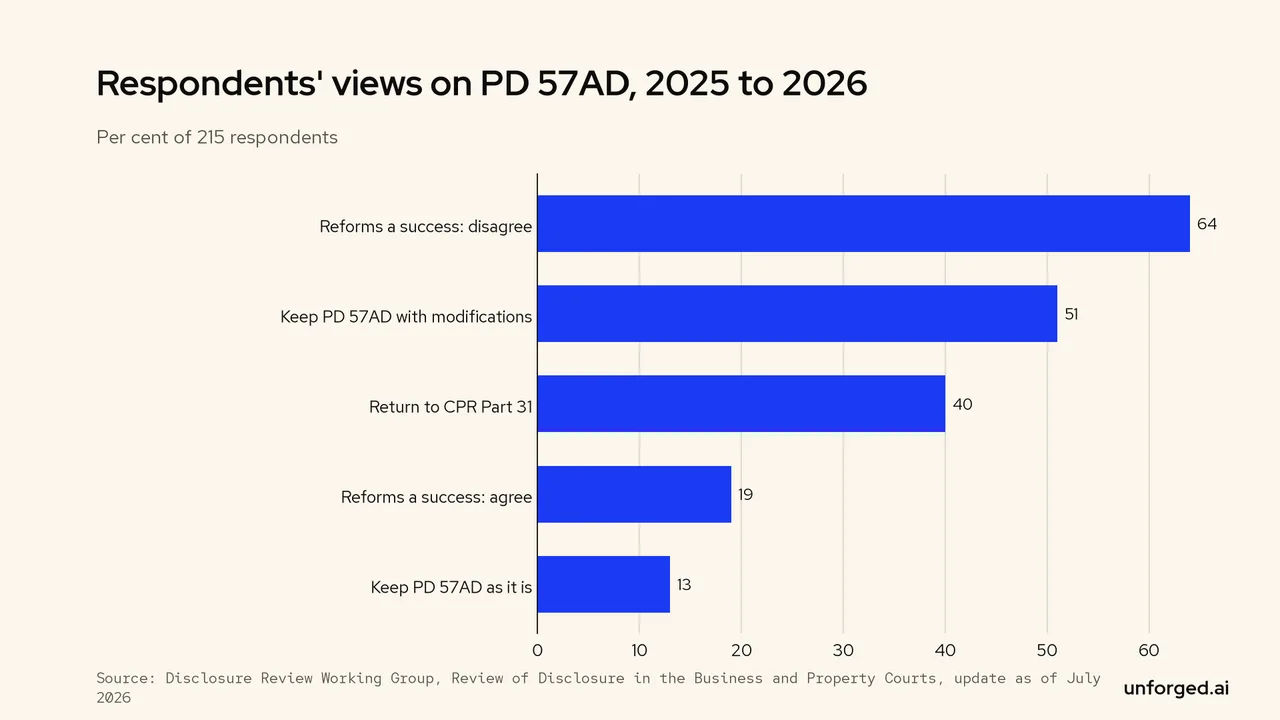
The criticism was mostly about cost, complexity and the Disclosure Review Document. Preservation came out differently: the group reports that the existing preservation obligations "were not generally seen as too onerous" and that there was strong support for keeping them, although some respondents raised practical issues about implementation and clarity, and clarifying the preservation obligations is among its reform themes. The group says it will not recommend a simple return to Part 31 and hopes to consult on proposals later in 2026 or early in 2027.
These are the views of the lawyers, judges and disclosure providers who chose to respond, not a measure of how the rules work across all cases. They do suggest that the duty to stop deleting, and to tell the people who hold the records, is not where respondents wanted the most change.
Keeping records through a dispute
Folio, our records product, is in private beta. In Folio you can place a hold on one record, a folder, a matter or everything about one person. While it's in place, nothing it covers is disposed of, deleted early or moved, and records filed into it later are covered too. Releasing a hold takes two people, each with a reason, and every hold and release goes in your ledger. Deciding what's relevant, and the litigation itself, stays with you and your advisers.
Sources
- Civil Procedure Rules, Practice Direction 57AD: Disclosure in the Business and Property Courts, paragraphs 1, 2, 3, 4 and 20
- PD 57AD Appendix 2, Disclosure Review Document, Section 2
- Civil Procedure Rules, Part 31: Disclosure and inspection of documents, rules 31.4, 31.8, 31.10 and 31.21
- Civil Procedure Rules, Practice Direction 31B: Disclosure of electronic documents, paragraphs 3 and 7 and the Electronic Documents Questionnaire
- Earles v Barclays Bank plc [2009] EWHC 2500 (Mercantile)
- Vardy v Rooney [2022] EWHC 2017 (QB)
- Criminal Procedure and Investigations Act 1996, section 23 and section 26
- Ministry of Justice, Criminal Procedure and Investigations Act 1996 (section 23(1)) Code of Practice, revised 2020
- UK GDPR, Article 17
- Ministry of Justice, Civil Justice Statistics Quarterly: April to June 2026, Business and Property Courts Table 1.1 and main Table 1.3
- Disclosure Review Working Group, Review of Disclosure in the Business and Property Courts: update as of July 2026